
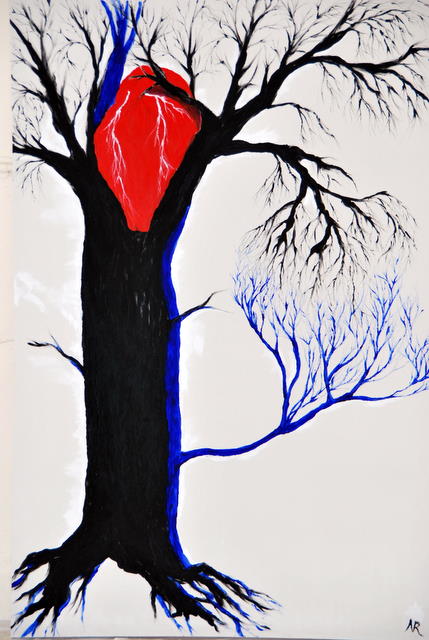


Price GBP 500


Holly (commissioned by a friend of her late dog)
Medical School Hannover, Hannover, Germany. henningzeidler@aol.com
The famous artists Pierre-Auguste Renoir (1841-1919) and Alexej von Jawlensky (1864-1941) had rheumatoid arthritis (RA). Both represent an outstanding example of successful coping with RA in former times when treatment was very limited, and these individuals took advantage of creativedisease management. The most popular French impressionist painter Renoir used his creativity to develop his own exercises and assistive equipments for painting despite his disability. Thus, Renoir exemplifies an artistic life altered by RA over more than 25 years that he dedicated entirely to his art and the depiction of beauty and happiness testified by his own words: “The pain passes, but the beauty remains.” Jawlensky, a Russian from origin, was one of the most important expressionist painter active in Germany and the first painter in the 20th century who created extensive series of paintings especially of human faces. From Jawlensky, we learned that his rapidly progressing, late-onset RA induced depression, disability, financial pressure, and social retreat. But the resulting artistic sublimation contributed to the change in his paintings, which we owe the more than 1000 series of the very unique, small-format “Meditations.”For those interested in art, new insight will be opened into the life and work of the artists and increase the appreciation for their contribution to modern art.
Center for Medical Humanities and Ethics, University of Texas Health Science Center, San Antonio, Texas, USA. klugman@uthscsa.edu
The Art Rounds program uses visual thinking strategies (VTS) to teach visual observation skills to medical and nursing students at the University of Texas Health Science Center San Antonio. This study’s goal was to evaluate whether students’ exposure to VTS would improve their physical observation skills, increase tolerance for ambiguity, and increase interest in learning communication skills.
In January 2010, 32 students attended three, 90-minute sessions at which they observed and commented on three pieces of art in small groups led by museum educators. Pre and posttest evaluations included Geller and colleagues’ version of Budner’s Tolerance of Ambiguity Scale, the Communication Skills Attitudes Scale, and free responses to art and patient images. Statistical analyses compared pre and post time looking at images, number of words used to describe images, and number of observations made according to gender and discipline.
Students significantly increased the amount of time they spent looking at art and patient images (P = .007), the number of words they used to describe art (P = .002) and patient images (P = .019), and the number of observations made of art (P = .000) and patient images (P = .001). Females increased the time spent observing significantly more than did males (P = .011). Students significantly increased their tolerance for ambiguity (P = .033) and positive views toward health care professional communication skills (P = .001).
The authors speculate that these improved skills may help in patient care and interprofessional team interactions.
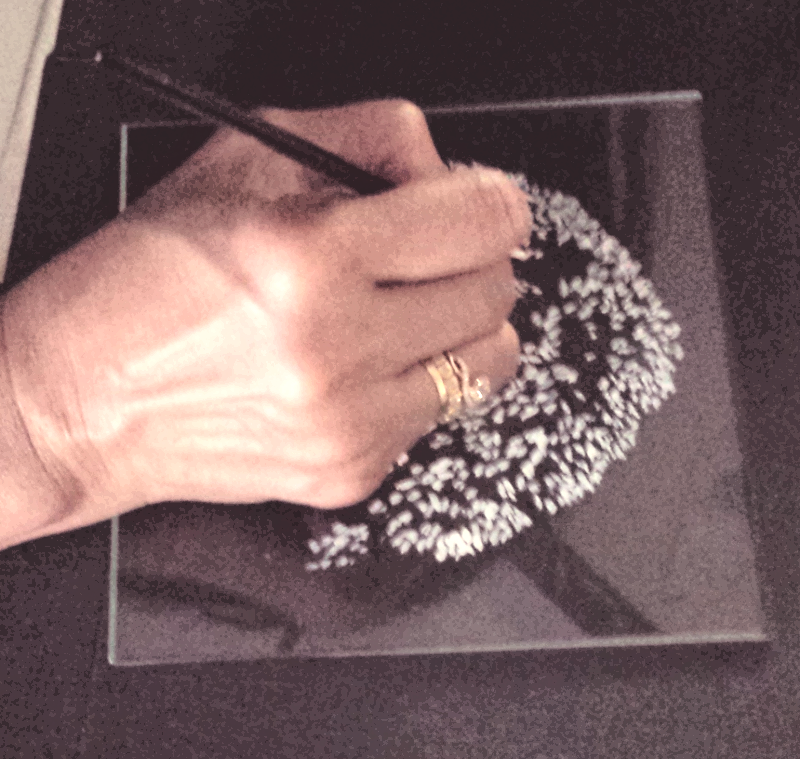
Verre églomisé – the art of reverse painting on glass using transparent colours and gold-leaf. This reverse painting on glass, is challenging but satisfying, as the painting begins with the highlights and details. It progresses towards the background as the last stage. It requires risk taking and bold judgement about the initial layers, because they are difficult to correct. Maybe that is why Nora finds this project attractive as it reflects the risk taking and judgement making skills of a practicing doctor.
She brings her visions and memories of her childhood growing up in the lush and green state of Johor, Malaysia and influence of her Sino Malay heritage into her art. By using the natural bright colours of the flora of the tropics Nora uses this technique to enliven her glass surface with a luminous, ethereal quality while transforming the plain glass. The pieces are rich, contrasting and gives depth while allowing for the play of light to bring life to the object being depicted. By exploiting the layering of color glazes combined with gold leaf makes these pieces durable, ensuring they last for decades.
 drnorarahman.com