
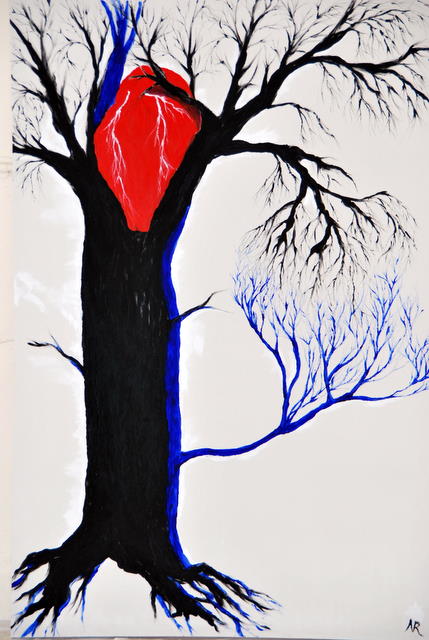


All about finger painting


Holly (commissioned by a friend of her late dog)
“Finger Painting can be more than “kid’s stuff” which belongs only in the kindergarten classroom and on the refrigerator door. Most of all I hope you will try it for yourself – you may discover something wonderful in the medium and in yourself as well” Mary Ann Brandt finger painter (June 21, 1921 – March 8, 2007)

Click here for your free book – finger painting Nora Rahman
“Finger Painting can be more than “kid’s stuff” which belongs only in the kindergarten classroom and
on the refrigerator door. Most of all I hope you will try it for yourself – you may discover something
wonderful in the medium and in yourself as well” Mary Ann Brandt finger painter (June 21, 1921 –
March 8, 2007)
Introduction
Historically finger painting is the most ancient art form. It is a technique involving painting with your
hands and fingers without any implements like brushes and palette knives. Although some modern
finger painting artists have used sticks, sponges, fabric instead of the traditional brush for the paint
application process, this strictly is not finger painting. In finger painting you use any part of your hand
and forearm to apply and spread paint on the canvas to express your creative thoughts.
You can use your nails, pulp of single or multiple digits, fists, knuckles, edge of your hands or
forearm. Use of any other part of your anatomy is called body painting. Fingers can be used not just
to apply the paint and draw but also to smooth and blend the paint on the canvas. The hand can be
used for smoothening paint and especially effective for large backgrounds. Individual strokes can be
created using the pulp of the fingers while varying your loading pressure. You can create short quick
strokes to long sweeping movements. Small stamping of dots and dabs are easily created with the
finger tips with direct application or by rolling the tip side to side.
The finger nails are excellent for fine details and drawing lines. You have good control and precise
strokes are easily achieved. Textural or pattern effects can also be created with the fingers using thick
paint. The difficulty is attempting for straight thick lines with fingers.
The advantage of finger painting is that you do not need to have extensive collection of brushes which
require maintenance and replacement. Also you cannot lose or misplace them! Cleaning is also much
easier with the fingers as most paints are easily removed with warm water and soap. And no more
excuses for not having the right brush for a particular stroke!
Your medium has to be heavy paper and preferably non absorbent to hold the thick paint. These can
be heavy construction paper, boards or special finger painting paper glossy on one or both sides.
Canvas is an option if you are looking at a more professional look.
Finger paints are readily available and are normally sold in packs of 6 brightly coloured pigments and
non toxic and easily washable which is strongly recommended for children’s use. To be cost effective
you can make your own paints using non toxic materials like corn flour and food colouring. Tempera
paint can also be used but should be thickened adding corn flour. It is preferable that the paint be
thick and gooey almost gelatinous in consistency to make its application and use optimal.
Most adult artists use acrylic or oil paints. You must be aware of the drying times for these especially
when paint is applied thick, it can be quite long (even years if applied thickly for the textured effect).
Acrylics dry quite fast but you need to be quick to apply them, but oil paints tend to take a longer
time. Spraying water on acrylics help to give you more time as it prevents drying. I have found
applying cling film over the paint prevents the paint from drying allowing for short breaks between
your painting sessions. Acrylics are water soluble and easier to clean.
Oil paints are ideal for finger painting but can be a bit caustic on your skin and you have to be sure
you do not have a reaction to them. This is mainly due to the pigment and solvents used to make
them. If you have not used them before try a little on your skin and leave for a few minutes and see if
you develop a skin reaction. If you do – avoid this paint. You can use gloves to paint but this may not
be as sensually satisfying as direct paint contact with your skin and your style will be different when
using gloves.
Finger painting with oil paints take longer to finish as they require drying but gives the artists time to
evolve their work .
8
Generally finger painting is commonly used as part of children’s preschool education. Most of us
have wonderful childhood memories of dipping our hands in thick gooey paint and smearing them on
paper with it and getting really messy and dirty and it was acceptable to do so. This activity was fun
and created an enthusiastic child who wanted to explore their creative side. It also produces great
comfort with the sensual element of paint on the fingers and the visual effects created with the
movements made on the paper. It has a part to play in the expression of the inner feelings and has
been used in therapy.
More adult artists are taking to finger painting as they feel more connected with their creation having
had a more intimate sensual experience while creating their work.
I hope you will take up this simple, satisfying and therapeutic art as a recreation and maybe even as a
passion and most of all enjoy yourself.
 drnorarahman.com