Glass and Gold

2013-05-12 19.37.57

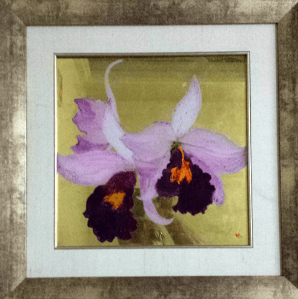
“Glass and Gold” collection, is Nora Rahman’s exploration into the area  of Verre églomisé – the art of  reverse painting on glass using transparent colours and  gold-leaf. This reverse painting on glass, is challenging but satisfying, as the painting begins with the highlights and details. It progresses towards the background as the last stage. It requires risk taking and bold judgements about the initial layers, because they are difficult to correct. Maybe that is why she finds this project attractive as it reflects the risk taking and judgement making skills of a practising doctor.

She brings her visions and memories of her childhood growing up in the lush and green state of Johore, Malaysia and influence of her Sino Malay heritage into her art. By using the natural bright colours of the flora of the tropics Nora uses this technique to enliven her glass surface with a luminous, ethereal quality while transforming the plain glass. The pieces are rich, contrasting and gives depth while allowing for the play of light to bring life to the object being depicted. By exploiting the layering of color glazes combined with gold leaf makes these pieces durable, ensuring they last for decades.

Utilizing visual art to enhance the clinical observation skills of medical students.

Med Teach. 2013 May 3. [Epub ahead of print]

Jasani SKSaks NS.

Source

Rush University Medical Center , USA.

Abstract

Background: Clinical observation is fundamental in practicing medicine, but these skills are rarely taught. Currently no evidence-based exercises/courses exist for medical student training in observation skills. Aim: The goal was to develop and teach a visual arts-based exercise for medical students, and to evaluate its usefulness in enhancing observation skills in clinical diagnosis. Methods: A pre- and posttest and evaluation survey were developed for a three-hour exercise presented to medical students just before starting clerkships. Students were provided with questions to guide discussion of both representational and non-representational works of art. Results: Quantitative analysis revealed that the mean number of observations between pre- and posttests was not significantly different (n = 70: 8.63 vs. 9.13, p = 0.22). Qualitative analysis of written responses identified four themes: (1) use of subjective terminology, (2) scope of interpretations, (3) speculative thinking, and (4) use of visual analogies. Evaluative comments indicated that students felt the exercise enhanced both mindfulness and skills. Conclusion: Using visual art images with guided questions can train medical students in observation skills. This exercise can be replicated without specially trained personnel or art museum partnerships.

A Free Book on Finger Painting

“Finger Painting can be more than “kid’s stuff” which belongs only in the kindergarten classroom and on the refrigerator door. Most of all I hope you will try it for yourself – you may discover something wonderful in the medium and in yourself as well” Mary Ann Brandt finger painter (June 21, 1921 – March 8, 2007)

finger painting 1

Click here for your free book – finger painting Nora Rahman

‘2 Mad Docs’ ‘We are not artists but medicine is our art!’ An exhibition of works by Nora Rahman and Vaikunthan Rajaratnam

images_blok_in_progres_600px

Following their exhibition at Red Gate Gallery earlier this year, the ‘2 Mad Docs’ are returning for a second exhibition of paintings and photographs. The ‘2 Mad Docs’ are Nora Rahman who is a GP in London and Vaikunthan Rajaratnam who is a surgeon in Birmingham. This exhibition explores the link between the practice of doctors and artists; the powers of observation and interpretation.

Nora’s current collection of paintings is entitled ‘Hands on Nature’ which is inspired by her recent travels both locally and abroad. She tries to capture the constant change of nature’s beauty and the transient delight of cyclical changes; daylight to night, weather changes and the wonderful seasons are evoked in her current series. She has used her hands to take snapshots of nature’s beauty.
Most of us have childhood memories of dipping our fingers into thick gooey paint and having a fantastic time. Fingers are great for painting. This process has captured Nora’s interests as she has continued to pursue this unusual process of producing art. She finds it very sensual, relaxing and therapeutic, allowing her to connect with her work. By employing a wider colour palette she has produced some exciting and engaging new work. Her love of art has continued to help her with her medical practice and enabled her to help her patients focus on the positive aspects of their health.

Raj continues his photographic series on the hand, entitled ‘The Working Hands’. For a surgeon, one of the most important functions of the hand is vocational. Raj has framed the hand in various settings being used to earn a livelihood – from the most gross and power grips to the more fine and subtle positions of the hand. He uses digital photography in his extended role as a surgical educator to impart surgical skills to his trainees to document the hand at work in its various settings. Some of these photographs are from his travels and from his work environment.

Private View: Saturday 24th of October 2009 – 6 pm to 11 pm
Exhibition runs from: Friday 23rd to Thursday 29th of October 2009
Gallery Opening Hours: Fri, Sat, Mon, Tues, Wed, Thurs: 2.30 pm – 6.30 pm
Sun: 5pm to 10.30pm
Last day of Exhibition: Thurs 29th of October: 11.00am to 5.00pm

Two Mad Docs Exhibition

: Works by Nora Rahman and Vaikunthan Rajaratnam

Red Gate Gallery, 209a Coldharbour Lane, London SW9 8RU


Private View: Saturday 24th of October 2009 – 6 pm to 11 pm

Exhibition runs from: Friday 23rd to Thursday 29th of October 2009
Gallery Opening Hours: Fri, Sat, Mon, Tues, Wed, Thurs: 2.30 pm – 6.30 pm
Sun: 5pm to 10.30pm
Last day of Exhibition: Thurs 29th of October: 11.00am to 5.00pm

Following their exhibition at Red Gate Gallery earlier this year, the ‘2 Mad Docs’ are returning for a second exhibition of paintings and photographs. The ‘2 Mad Docs’ are Nora Rahman who is a GP in London and Vaikunthan Rajaratnam who is a surgeon in Birmingham. This exhibition explores the link between the practice of doctors and artists; the powers of observation and interpretation

Though not artists by trade and training they have in this collection of works compiled their impression of the Art of Medicine. It includes works of paintings and digital photographs on the human aspects and beauty of medicine and surgery. It explores the inner soul of these doctors who spend much of their waking hours caring for their patients and with little time and opportunity for creativity.
Nora had some formal training in art in her younger days and continues to explore her creative side with drawings, paintings and recently with pottery, glass fusion and Raku. In spite of her busy schedule as a full time doctor working in the city and bringing up 2 children, Nora has found the time to express herself in some new exciting work. Recently she has experimented with finger painting and has produced some surprises and finds this avenue extremely therapeutic for her hectic life style. Her recent works include the emotional aspect of medicine as seen by a doctor in her practice.
Raj, a hand surgeon by training working in Birmingham is passionate about the beauty of the hand. Having had more than 2 decades of experience in educating and training surgeons worldwide, he has used photography as his medium for teaching surgery. Recently with digital photography he has explored the fascinating world of hand surgery as seen through a lens. This collection of his digital work shows the beauty of the hand in the young and old and in the diseased state. It gives an insider’s view of surgery of the hand and the hand in all its glorious functions.

As part of the private viewing night Nora & Raj will invite visitors to join in a happening of live collective finger and hand painting – participants are able to re-discover the fun, interaction and creativity of past playschool memories. The collective finger/hand paintings will with permission of the participants be exhibited in Nora & Raj’s next project.
Exhibitions

Two Mad Docs An exhibition of works by Nora Rahman and Vaikunthan Rajaratnam

20. Feb – 5. Mar 09 / endedRed Gate Gallery

Fri from 2.30pm

Two Mad Docs

Private View: Friday 20th of February 2009 – 6 pm to 11 pm
Exhibition runs from: Friday 20th of February to 5th of March 2008
Gallery Opening Hours: Fri, Sat, Mon, Tues, Wed: 2.30 pm – 6.30 pm
Last day of Exhibition: Thurs 5th of March: 11.00am to 5.00pm

‘The two mad docs’ are two professional doctors who have been practicing medicine for the last 30 years, and having worked and lived in the Far East prior to moving to the UK in 2000.
Though not artists by trade and training, in this collection they have compiled their personal interpretation of the ‘Art of Medicine’. The exhibition includes paintings and digital photographs of the body; expressing the beauty of medicine and surgery, and giving these doctors, who ordinarily spend so much of their time caring for patients and others, the chance to explore their inner soul and imaginations.
Nora, with some formal art training in her youth, now continues to explore her creative side with drawings, paintings and more recently, pottery, glass fusion and Raku. In spite of her busy schedule as a full time doctor working in the city and bringing up 2 children, Nora has found the time to express herself in some exciting new work – experimenting with finger painting, an extremely therapeutic technique, and producing some surprising and engaging work. Her most recent pieces delve into the emotional side of medicine as seen from her perspective as a doctor.
Raj, a hand surgeon currently working in Birmingham, is passionate about the beauty of the body parts he works with every day. With more than 2 decades of experience in educating and training surgeons worldwide using digital photography in his teaching practices, he has now transferred these skills to the world of art in order to explore through the camera, the fascinating world of hand surgery in more detail. This collection of his digital work showcases a variety of models; the young, the old, the healthy, and diseased, and gives an insider’s view of hand surgery in all its glory.
As part of the private viewing night Nora & Raj will invite visitors to join in a happening of live collective finger and hand painting – participants are able to re-discover the fun, interaction and creativity of past playschool memories. The collective finger/hand paintings will with permission of the participants be exhibited in Nora & Raj’s next project.

Finger Painting

“Finger Painting can be more than “kid’s stuff” which belongs only in the kindergarten classroom and
on the refrigerator door. Most of all I hope you will try it for yourself – you may discover something
wonderful in the medium and in yourself as well” Mary Ann Brandt finger painter (June 21, 1921 –
March 8, 2007)

Introduction
Historically finger painting is the most ancient art form. It is a technique involving painting with your
hands and fingers without any implements like brushes and palette knives. Although some modern
finger painting artists have used sticks, sponges, fabric instead of the traditional brush for the paint
application process, this strictly is not finger painting. In finger painting you use any part of your hand
and forearm to apply and spread paint on the canvas to express your creative thoughts.
You can use your nails, pulp of single or multiple digits, fists, knuckles, edge of your hands or
forearm. Use of any other part of your anatomy is called body painting. Fingers can be used not just
to apply the paint and draw but also to smooth and blend the paint on the canvas. The hand can be
used for smoothening paint and especially effective for large backgrounds. Individual strokes can be
created using the pulp of the fingers while varying your loading pressure. You can create short quick
strokes to long sweeping movements. Small stamping of dots and dabs are easily created with the
finger tips with direct application or by rolling the tip side to side.
The finger nails are excellent for fine details and drawing lines. You have good control and precise
strokes are easily achieved. Textural or pattern effects can also be created with the fingers using thick
paint. The difficulty is attempting for straight thick lines with fingers.
The advantage of finger painting is that you do not need to have extensive collection of brushes which
require maintenance and replacement. Also you cannot lose or misplace them! Cleaning is also much
easier with the fingers as most paints are easily removed with warm water and soap. And no more
excuses for not having the right brush for a particular stroke!
Your medium has to be heavy paper and preferably non absorbent to hold the thick paint. These can
be heavy construction paper, boards or special finger painting paper glossy on one or both sides.
Canvas is an option if you are looking at a more professional look.
Finger paints are readily available and are normally sold in packs of 6 brightly coloured pigments and
non toxic and easily washable which is strongly recommended for children’s use. To be cost effective
you can make your own paints using non toxic materials like corn flour and food colouring. Tempera
paint can also be used but should be thickened adding corn flour. It is preferable that the paint be
thick and gooey almost gelatinous in consistency to make its application and use optimal.
Most adult artists use acrylic or oil paints. You must be aware of the drying times for these especially
when paint is applied thick, it can be quite long (even years if applied thickly for the textured effect).
Acrylics dry quite fast but you need to be quick to apply them, but oil paints tend to take a longer
time. Spraying water on acrylics help to give you more time as it prevents drying. I have found
applying cling film over the paint prevents the paint from drying allowing for short breaks between
your painting sessions. Acrylics are water soluble and easier to clean.
Oil paints are ideal for finger painting but can be a bit caustic on your skin and you have to be sure
you do not have a reaction to them. This is mainly due to the pigment and solvents used to make
them. If you have not used them before try a little on your skin and leave for a few minutes and see if
you develop a skin reaction. If you do – avoid this paint. You can use gloves to paint but this may not
be as sensually satisfying as direct paint contact with your skin and your style will be different when
using gloves.
Finger painting with oil paints take longer to finish as they require drying but gives the artists time to
evolve their work .
8
Generally finger painting is commonly used as part of children’s preschool education. Most of us
have wonderful childhood memories of dipping our hands in thick gooey paint and smearing them on
paper with it and getting really messy and dirty and it was acceptable to do so. This activity was fun
and created an enthusiastic child who wanted to explore their creative side. It also produces great
comfort with the sensual element of paint on the fingers and the visual effects created with the
movements made on the paper. It has a part to play in the expression of the inner feelings and has
been used in therapy.
More adult artists are taking to finger painting as they feel more connected with their creation having
had a more intimate sensual experience while creating their work.
I hope you will take up this simple, satisfying and therapeutic art as a recreation and maybe even as a
passion and most of all enjoy yourself.

Nora, with some formal art training in her youth, now continues to explore her creative side with drawings, paintings and more recently, pottery, glass fusion and Raku. In spite of her busy schedule as a full time doctor working in the city and bringing up 2 children, Nora has found the time to express herself in some exciting new work – experimenting with finger painting, an extremely therapeutic technique, and producing some surprising and engaging work. Some of Nora’s pieces delve into the emotional side of medicine as seen from her perspective as a doctor.

Nora mugshot